Sunday, February 8, 2015

Foie Gras -- Strong Liver Anybody?

Humphry Slocombe, a California ice-cream parlour, introduced foie gras ice-creams and sandwiches in 2008. The shop initially offered it only as an occasional delicacy, but when it became clear in 2012 that the state was about to ban foie gras, the demand for the products spiked. "We started serving it everyday till the last day possible" said Jake Godby, the chef and founder of Humphry Slocombe.

What is foie gras?

"Foie" in French means "liver" and "gras" in French means "fat". So, "foie gras" means the fattened liver of a force-fed goose or duck.

Who cares about it?

Foie gras consists mostly of fat, and its richness makes it a good match for sweet foods, which is why it’s often served with dessert wine. Another advantage of pairing foie with other high-fat ingredients like eggs and cream is that a little will go a long way. Foie gras is expensive - restaurants and distributors quoted me wholesale prices between $35 and $55 a pound, depending on quality - and most of these dishes are best served in small portions. Humphry Slocombe can make a gallon of foie gras ice cream with a single 1- to 2-pound lobe of foie. In turn, it makes about 100 $5 sandwiches out of that gallon.

Americans and French are heavy consumers of foie gras products. Many other countries also import foie gras and such dishes command a high price and following.

How is it prepared?

Poultry farm workers ram pipes down the male ducks' or geese's throats two or three times daily and pump as much as 4 pounds of grains and fats into animals' stomachs, causing their livers to swell up to 10 times their normal size. Many birds have difficulty standing because of their engorged livers, and they may tear out their own feathers and cannibalize each other out of stress. The birds are kept in tiny cages or packed into sheds. On some farms, a single worker may be expected to force-feed 500 birds three times each day. Because workers rush, animals are often treated roughly and left injured and suffering.

Is it so cruel?

Foie gras was banned in California in July 2012, on the ground that it was cruel to force-feed a duck to fatten its liver. Force-feeding has also been outlawed in Austria, the Czech Republic, Denmark, Finland, Germany, Israel, Italy, Luxembourg, the Netherlands, Norway, Poland, South Africa, Sweden, Switzerland, and the U.K. India has banned the import of foie gras, meaning that it cannot legally be sold anywhere in the country.

A PETA investigation at Hudson Valley Foie Gras in New York (then called “Commonwealth Enterprises”) found that so many ducks died when their organs ruptured from overfeeding that workers who killed fewer than 50 birds per month were given a bonus. Many ducks develop foot infections, kidney necrosis, spleen damage, bruised and broken bills, and tumor-like lumps in their throats. One duck had a maggot-infested neck wound so severe that water spilled out of it when he drank.

Another PETA investigation at Hudson Valley in 2013 documented that prior to the force-feeding period, young ducks were crammed by the thousands into huge warehouse-like sheds in conditions that are virtually identical to those for “broiler” chickens and turkeys on factory farms. Ducks who were being force-fed were confined up to a dozen at a time to a pen measuring just 4 feet by 6 feet. PETA’s investigator saw workers drag ducks by their necks along the wire floor and pin the ducks between their legs before ramming the metal force-feeding tubes down their throats.


By Hudson Valley’s own calculations, approximately 15,000 ducks on the farm die every year before they can be slaughtered. Common causes of death on foie gras farms include ruptured organs, throat injuries, liver failure, and heat stress—all direct results of force-feeding. Some ducks die of aspiration pneumonia, which occurs when the grain is forced down into the ducks’ lungs or when birds choke on their own vomit. Ducks at Hudson Valley are killed on site, and PETA’s investigator documented at least one bird still moving after his throat had been cut.

What you may choose to do?

Unfortunately, a recent ruling in California has overturned the previous ban. And life in California will continue to be a part of the pains suffered by the foie gras animals. If you have any intention of eating foie gras, I request you to please reconsider.

Sunday, January 18, 2015

State of the World

Below is a representation of the whole world as a group of 100 people. Different aspects of lives of human beings have been depicted. A very interesting reading indeed.


Sunday, January 4, 2015

Agriculture -- A Primer

Why should we bother about knowing Agriculture? The single most important reason I would give is that "It feeds us and we must know how it works and what is its state of affairs to be continually supplied food". News about agriculture is taking prominence across the world and everybody from the politician to the corporate honchos are taking note of it. They are seeing growth and business opportunities in the vast field of Agriculture. If Agriculture improves, more than 805 million people of the world will not sleep hungry, more than 161 million of children will not remain severely malnourished, farmers will get due compensation, cheap and quality products will reach the consumers and the whole ecosystem around the food supply-chain in the world will gain strength and vitality. So, we need to know all we can about Agriculture to secure our own future.

Agriculture [कृषि]

It is defined as "cultivation of land, including horticulture, fruit growing, crop and seed growing, dairy farming and livestock breeding."

Cultivation [खेती]

It means "to dig and manure the soil to ready for growing crops".

Soil [मिट्टी]

It is the thin layer of surface earth. It is composed of mineral particles, decayed organic matter and water.

Topsoil :- It is the upper part of the soil. Water washes away the organic matter and minerals from the topsoil to the subsoil.

Topsoil can be sub-classified into the following.
  • Chernozem :- A dark fertile topsoil, rich in organic matter, found in the temperate grass-covered plains of Russia, North and South America. It is also known as black earth.
  • Loess :- A fine fertile soil formed of tiny clay and slit particles deposited by the wind. It is most commonly found in Mississippi Valey and Europe and Asia.
  • Podsol :- A type of acid soil where organic matter and mineral elements have been leached from the light-coloured top layer into a darker lower layer through which water does not flow and which contains little organic matter. On the whole podsols make poor agricultural soils, owing to their low nutrient status and the frequent presence of an iron pan. Large areas of the coniferous forest regions of Canada and Russia are covered with podsols.

Subsoil :- It is the lower part of the soil beneath the topsoil.

Substratum :- It is the layer of rocks beneath the subsoil.

In waterless and sun-dried regions, there is often no difference between the topsoil and the subsoil.  
 
How is soil formed?
 
At first the earth surface was solid rock. The simple but giant-strong agents that beat the rocks into powder or soil with a clublike force millionfold more powerful than the force of Hercules club were chiefly - 1). heat and cold, 2). water, frost and ice, 3). a very low form of vegetable life and 4). tiny organisms. In some cases, these forces acted singly, in some other, all acted together to rend and crumble the unbroken stretch of rock.

Humus [खाद मिट्टी]

It is the fibrous organic matter in the soil formed from the decomposed plants and animal remains, which makes the soil dark and binds them together.

Tillage [जुताई]

It is act of preparing the soil for cultivation. The stirring of the soil enables the air to circulate through it freely, and permits a breaking down of compounds that contain the elements necessary to plant growth.

Zero Tillage

It is a technique using herbicides instead of tilling the soil before sowing an arable crop by direct drilling.


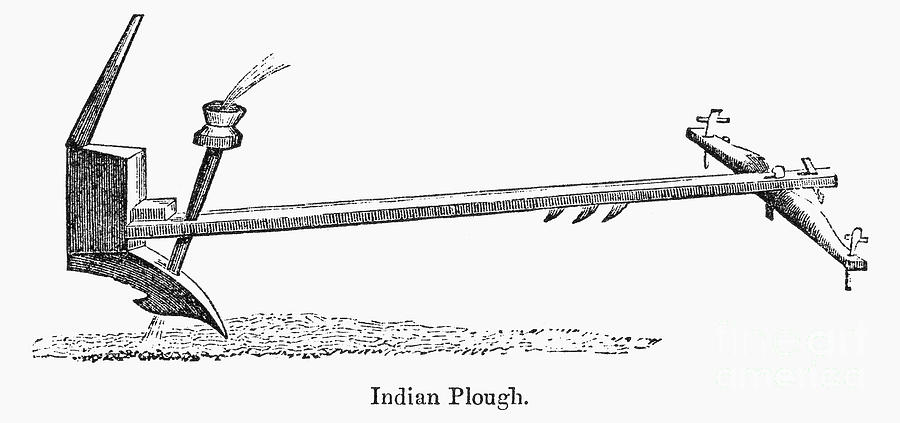
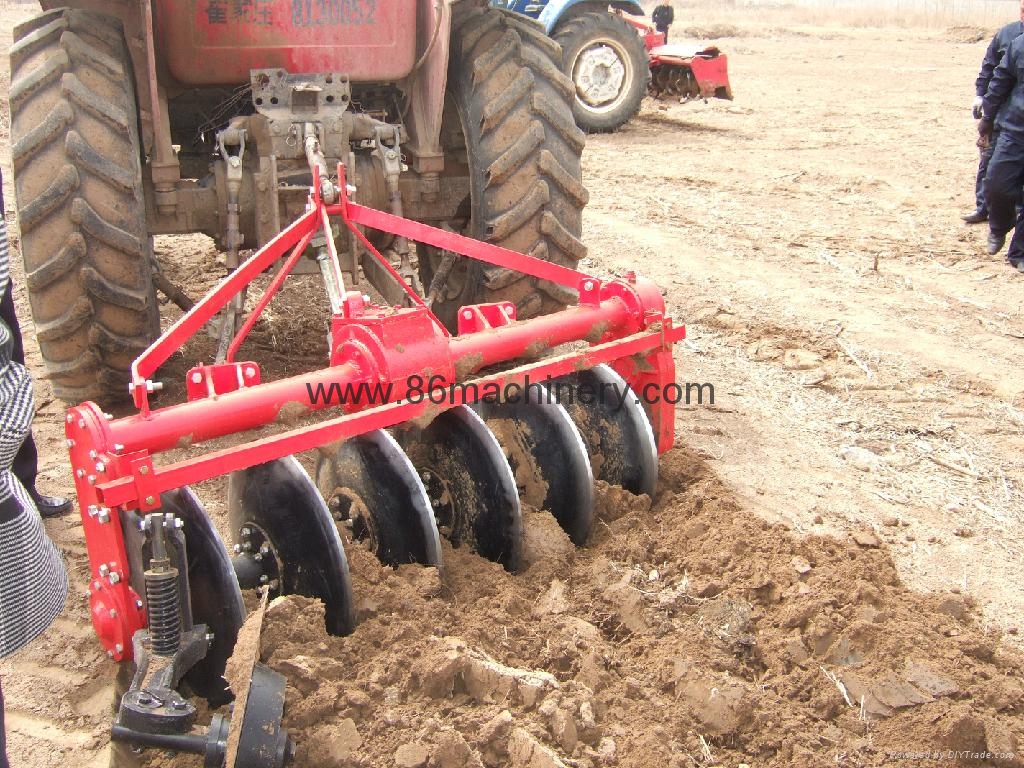
Plough [हल]


Wooden Indian Plough

Plough attached to a tractor

It is an implement or machine used to turn over the surface of the soil in order to cultivate crops. The machine uses a strong blade which is fit at the end of a beam.

The modern plough is usually fully mounted on a tractor's hydraulic system, though some are semi-mounted, with the rear supported by one or more wheels, and some may be trailed. The principal parts of a plough are the beam or frame, made of steel, to which are attached a number of parts which engage the soil, such as the disc coulter, the share and the mouldboard which turns the furrow slice. 

There are three main types of plough - conventional with right-handed mouldboards, reversible with left or right-handed mouldboards and disc ploughs.

The three main methods of ploughing are systematic, where the field is divided into lands by shallow furrows, round and round ploughing, in which fields are ploughed from the center to the outside or from the edge to the center, reversible ploughing, where the field is ploughed up and down the same furrow, giving a very level surface. Square ploughing is another method suitable for large areas. A piece of land is ploughed in the center of a field and then the field is ploughed in a clockwise direction starting from this central point.

Importance of Tilling and Ploughing

If the soil is fertile and if deep plowing has always been done, good crops will result, other conditions being favorable. If, however, the tillage is poor, scanty harvests will always result. For most soils a two-horse plow is necessary to break up and pulverize the land.

A shallow soil can always be improved by properly deepening it. The principle of greatest importance in soil-preparation is the gradual deepening of the soil in order that plant-roots may have more comfortable homes. If the farmer has been accustomed to plow but four inches deep, he should adjust the plow so as to turn five inches at the next plowing, then six, and so on until the seed-bed is nine or ten inches deep. This gradual deepening will not injure the soil but will put it quickly in good condition. If to good tillage rotation of crops be added, the soil will become more fertile with each succeeding year.


Soil Moisture Deficit 

It is the difference between the amount of water that is in a soil and the amount needed for crops to grow successfully. Abbreviation. SMD

TO BE CONTINUED


Saturday, January 3, 2015

Stock Exchanges in India -- A Brief Primer

A security is a financial instrument which is assigned a value and is traded. Examples of a security include a note, stock, preferred share, bond, debenture, option, future, swap, right, or warrant or virtually any other financial asset. Traditionally, it was a physical document but of late, specially in 21st century, it is majorly an electronic document.

A security can be classified into 3 categories - debt, equity and and derivatives. A debt security represents a borrowed fund that must be repaid. The buyer of a debt security effectively lends the issuer a fixed amount of money in exchange for the security, which gives the holder a right to receive interest payment and the principal at the maturity. 

An equity security is also called stock. It represents a proportional claim in an organization's assets and profits. Ownership in the company is determined by the number of shares a person owns divided by the total number of shares outstanding. For example, if a company has 1000 shares of stock outstanding and a person owns 50 of them, then he/she owns 5% of the company. Most stock also provides voting rights, which give shareholders a proportional vote in certain corporate decisions. Only a certain type of company called a corporation has stock; other types of companies such as sole proprietorships and limited partnerships do not issue stock.

A derivative security is an instrument whose value is derived from the value and characteristics of another security. Examples are future, option and forward contracts. It is a very important part of the whole financial security market. Read more in details about it.


The holder may at his/her discretion decide to sell the security  and the new owner becomes eligible to receive all the benefits associated to that security.

A stock exchange is any body of individuals, whether incorporated or not, constituted for the purpose of assisting, regulating or controlling the business of buying, selling or dealing in securities. It does not own any security on its own. Stock exchanges are indispensable for the smooth and orderly functioning of corporate sector in a free market economy. A stock exchange need not be treated as a place for speculation or a gambling den. It should act as a place for safe and profitable investment, for this, effective control on the working of stock exchange is necessary. This will avoid misuse of this platform for excessive speculation, scams and other undesirable and anti-social activities.

Stock exchanges maintain an official list of securities that could be purchased and sold on its floor. Securities which do not figure in the official list of stock exchange are called unlisted securities. Such unlisted securities cannot be traded in the stock exchange.
Here is the list of active stock exchanges in India.

Sr. No. Name of the Exchange Valid Upto
1 Ahmedabad Stock Exchange Ltd.

Address: Kamdhenu Complex Opp, Sahajanand College, Panjarapole, Ambawadi, Ahmedabad - 380001
PERMANENT
2 BSE Ltd.

Address: P J Tower, Dalal Street, Mumbai 400023
PERMANENT
3 Bangalore Stock Exchange Ltd.

Address: Stock Exchange Towers, 51, 1st Cross, J C Road, Bangalore - 560027
Exiting Soon
4 Bhubaneswar Stock Exchange Ltd

Address: Stock Exchange Bhavan, P- 2, Jayadev Vihar, P. O. - Chandrasekharpur, Bhubaneswar - 751023
04-JUN-2014
5 Calcutta Stock Exchange Ltd.

Address: 7, Lyons Range, Kolkata - 700001
PERMANENT
6 Cochin Stock Exchange Ltd

Address: MES Dr P. K. Abdul Gafoor Memorial Cultural Complex, 36/1565, 4th Floor, Judges Avenue, Kaloor, Cochin - 682017
07-NOV-2013
7 Delhi Stock Exchange Ltd.,The

Address: DSE House, 3/1, Asaf Ali Road, New Delhi - 110002
PERMANENT
8 Gauhati Stock Exchange Ltd.,The

Address: Saraf Building Annexe, A T Road, Gauhati - 781001
30-APR-2013
9 Inter-Connected Stock Exchange of India Limited

Address: International Infotech Park, Tower 7, 5th Floor, Sector 30, Vashi, Navi Mumbai - 400703
17-NOV-2014
10 Jaipur Stock Exchange Ltd 08-JAN-2015
11 Ludhiana Stock Exchange Ltd.,The

Address: Feroze Gandhi Market, Ludhiana - 141001
27-APR-2014
12 MCX - Stock Exchange Limited

4th Floor, Vibgyor Tower, Plot No C 62, G Block, Bandra Kurla Complex (BKC), Bandra (E), Mumbai - 400051
15-SEP-2015
13 Madhya Pradesh Stock Exchange Ltd

Address: Palika Plaza, Phase II, 201, 2nd Floor, MTH Compound, Indore - 452001
PERMANENT
14 Madras Stock Exchange Ltd.

Address: P O Box no 183, New No: 30 (old No: 11) Second Line Beach, Chennai - 600001
PERMANENT
15 Magadh Stock Exchange Ltd.

"SEBI vide order dated September 3, 2007 refused to renew the recognition granted to Magadh Stock Exchange Ltd."
16 National Stock Exchange of India Ltd.

Address: Bandra Kurla Complex, Bandra (East) Mumbai 400051
PERMANENT
17 OTC Exchange of India

Address: 92, Maker Towers 'F', Cuffe Parade, Mumbai - 400005
22-AUG-2014
18 Pune Stock Exchange Ltd

Address: Shivleela Chambers, 752, Sadashiv Peth, RB Kumthekar Marg Pune - 411030
01-SEP-2014
19 The Vadodara Stock Exchange Ltd.

Address: Fortune Tower, Sayajigunj, Vadodara - 390005
03-JAN-2015
20 U.P. Stock Exchange Limited

Address: Padam Towers, 14/113, Civil Lines, Kanpur - 208001
02-JUN-2014
21 United Stock Exchange of India Limited

Office no 3 to 6, 7th Floor, Arcadia Building, 195,N.C.P.A Marg, Nariman Point, Mumbai-400021
21-MAR-2015

Sunday, December 28, 2014

Tie Knot -- A Statistician's Marvel

Men of all ages knot their tie. The resultant bow of the knot looks pretty on its wearer and enhances there look as well. Getting that knot the way we want is not that easy after all. I would say it is an art. It’s a sad fact, but there are grown men who don’t know how to knot a tie. If they have a big interview that afternoon, they’ll go shopping for a clip-on. Even if a man does know how to tie a tie, their knowledge is often limited to just one necktie knot. But there are several ways to tie a tie. Certain necktie knots should be used with certain shirt collars and tie fabric materials to get the best results for your appearance. Some popular and important variations are described in the figure below.


How simple or complex is this art of knotting a tie? J.D.Lenzen is an artist who specializes in tie knots. He considers knot tying a creative practice rather than an unchanging discipline. Knots, he believes, are like paintings. Twists, coils and weaves replace the pigments and the length of the tie becomes the canvas. J.D. Lenzen is the creator of the highly acclaimed YouTube channel "Tying It All Together", and the producer of nearly 300 instructional videos. He's been formally recognized by the International Guild of Knot Tyers (IGKT) for his contributions to knotting, and is the originator of Fusion Knotting—the creation of innovative knots and ties through the merging of different knot elements or knotting techniques.

His published instructional books include Paracord Fusion Ties - Volume 2 (2013), Paracord Fusion Ties - Volume 1 (2012) and Decorative Fusion Knots (2011). His fourth instructional book, Paracord Project Inspirations will be available online and in stores, later this year (2014).

Recently, mathematician Mikael Vejdemo-Johansson, at the KTH Royal Institute of Technology in Stockholm, and colleagues have come up with a mind boggling 177,147 variations of knotting a tie. The inspiration for the work apparently came from the fiendishly complex knot sported by the “Merovingian” villain from the Matrix films. The number Vejdemo-Johansson and pals came up with is a vast increase on the 85 ways that physicists Thomas Fink and Yong Mao from the Cavendish Laboratory in Cambridge found in 2000. According to Vejdemo-Johansson, their number is much larger because Fink and Mao made various assumptions about tie knots that drastically reduced the number available, including that tie-wearers would only make a “tuck” – pushing the tie into the knot to lock it in place – at the end of a given tying sequence.

Next time you lay hand on your tie, try out a different knot and remember you have several more to attempt. It is an art and not just a step in decoration. :)

Sunday, December 7, 2014

Microbenchmarks -- A step to avoid towards Software Performance Tuning

Performance Improvements in a large-scale software application is often taken right at the end or when a critical issue is reported by customers or other stakeholders. The more the age and adoption of the product, the more is the expectation that the product will run slower than before. The key is always in writing code with good and time-tested algorithms. And when you still have to undertake performance tuning, a meticulous approach is what is required. One of them is called Microbenchmarking.

A microbenchmark is a test designed to measure a very small unit of performance e.g. the time to call a synchronized method versus a nonsynchronized method, the overhead in creating a thread vs. using a thread pool, the time taken to execute one algorithm against another etc. Doesn't this sound interesting? Yes, they are the basic building blocks of the whole exercise of bettering Software application performance.

Unfortunately, it is often very difficult to write a correct microbenchmark. Consider the following code.

public void doTest()
{
     // Main Loop
     double l;
     long then = System.currentTimeMillis();

     
     for (int i = 0; i < nLoops; i++)
         l =
generateFibonacci(50);
     long now = System.currentTimeMillis();
     System.out.println("Elapsed time: " + (now - then));
}
 

...
 

private double generateFibonacci (int n)
{
    if (n < 0) throw new IllegalArgumentException("Must be > 0");
    if (n == 0) return 0d;
    if (n == 1) return 1d;
    double d = fibImpl1(n - 2) + fibImpl(n - 1);
    return d;
}


The calculated Fibonacci numbers in the function generateFibonacci are never read. This gives a freehand to the compilers in JVM 7 and 8 to discard the calculations. All smart compilers will end up in executing the following code and skip the function altogether.


public void doTest()
{
     // Main Loop
     double l;
     long then = System.currentTimeMillis();

 
    long now = System.currentTimeMillis();
     System.out.println("Elapsed time: " + (now - then));
}


The program will always print the elapsed time as a few milliseconds irrespective of the implementation of the Fibonacci method or the number of times the loop is supposed to be executed. This defeats the very purpose of the test. So, what can we do to get around this problem?

Make sure that each and every computed value is read in some way or the other. One easy way to do that is to make sure that the computations are read into an instance field which is preferably a volatile. The need to use a volatile variable in this example applies even when the microbenchmark is single-threaded.

Be especially wary when thinking of writing a threaded microbenchmark. When several threads are executing small bits of code, the potential for synchronization bottlenecks (and other thread artifacts) is quite large. Results from threaded microbenchmarks often lead to spending a lot of time optimizing away synchronization bottlenecks that will rarely appear in real code—at a cost of addressing more pressing performance needs.


Consider the case of two threads calling a synchronized method in a microbenchmark. Because the benchmark code is small, most of it will execute within that synchronized method. Even if only 50% of the total microbenchmark is within the synchronized method, the odds that as few as two threads will attempt to execute the synchronized method at the same time is quite high. The benchmark will run quite slowly as a result, and as additional threads are added, the performance issues caused by the increased contention will get even worse. The net is that the test ends up measuring how the JVM handles contention rather than the goal of the microbenchmark.

In a microbenchmark, the inputs must be precalculated. The test must not spend time in finalizing the inputs. One of the performance characteristics of Java is that code performs better the more it is executed, a topic that is covered in Chapter 4. For that reason, microbenchmarks must include a warm-up period, which gives the compiler a chance to produce optimal code. The advantages and disadvantages of a warm-up period are discussed in depth later in this chapter. For microbenchmarks, a warm-up period is required; otherwise, the microbenchmark is measuring the performance of compilation rather than the code it is attempting to measure.

Writing a microbenchmark is hard. There are very limited times when it can be useful. Be aware of the pitfalls involved, and make the determination if the work involved in getting a reasonable microbenchmark is worthwhile for the benefit—or if it would be better to concentrate on more macro-level tests.

 
References

Java Performance : The Definitive Guide
JVM Specifications

Saturday, December 6, 2014

Happy Birthday!!! Subscriber Trunk Dialling

On a fine afternoon of 5 December, 1958, Her Majesty, Queen of UK, took a revolutionary step towards making a trunk call without the involvement of an operator. She phoned 031 CAL 3636, the Lord Provost of Edinburgh from the central telephone exchange in Bristol, more than 300 miles (482km) away. It also marked the birth of Subscriber Trunk Dialling (STD). Till that day, all long distance calls were made with the help of a human operator.

The Queen dialling what came to be known as the first STD call

18,000 subscribers in Bristol were given the first opportunity to make trunk calls. All the calls were charged based on distance and time both. It was big day in the history of communications and the staff at Bristol Telephone Exchange was very excited. Brian Fox, a fresh faced engineer who had only finished his apprenticeship three months before, stood only feet from the Queen when she made that historic call.

It was one of the most important days ever in telecommunications history and a huge amount of work went into making sure the day went without a hitch. The walkway from Telephone Avenue was tented and full of flowers and a powder room for the Queen was hastily provided in a converted control room.
We stood between rows of equipment as close as we could get and watched Her Majesty dial the number. When it was all over and the Queen was leaving the Duke of Edinburgh remarked, 'you can relax now chaps, it all works'!
International subscriber dialling (ISD) was introduced on 8 March 1963, when London subscribers were able to dial Paris numbers directly.